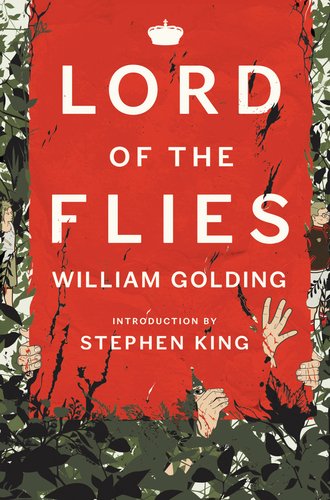
As part of the "DEAR" (Drop Everything And Read) program implemented by my school, DJIS, we students have been reading for 30 mins at school on each Thursday. Through this accumulation of time spent reading, I have gained valuable insight and enjoy reading now.
The book I chose was "Lord of the Flies" by William Golding. In this entertaining novel, Golding describes the struggle of a group of British boys stuck on a remote island. They try to govern themselves but fail miserably. Golding does a great job at describing each boy and his characteristics. Through reading about the boys' struggle at working together, I learned how to think responsibly and not make rash decisions. I highly recommend this novel to everybody and thank Mr.Ammar and the English department for adding such a beneficial program.
"Words can inspire. And
words can destroy. Choose yours well." This assertion stated by Robin
Sharma elucidates Mohammed Qahtani's argument in the simplest of forms. For the
most part, the majority of society takes no discretion when speaking to others
and utters whatever crosses their minds without considering the deleterious consequences
they might have on others such as in Qahtani's example about his friend Nasser.
In his speech, "The Power of Words",
Qahtani addresses the topic by giving various examples of how people were
affected, positively and negatively, by mere words. What strikes me the most
about his presentation is his articulacy and persuasiveness. Just one minute in,
I had already been deceived by Oahtani's eloquence and fully believed him up
until he confessed he was lying. The most important thing I truly learned from
his presentation was that the way words are delivered is of extreme importance.
For example, Qahtani mentions how people who cannot articulate words in a
powerful and expressive manner will not be taken seriously such as was the case
with the scientists who tried to talk about global warming on the television.
In order to grab the audience's attention in any public speaking event, the
speaker himself should be as fluent, expressive, and convincing as possible. Even
if something is extremely important but is not articulated in the most
persuasive manner, it will have no effect on the people being addressed.
https://www.pinterest.com/pin/18295942211940126/
Before watching Nasser's
presentation I did not take much care with my words but now, after watching, I will
exercise extreme caution when speaking; something of trifling significance may
prove to be detrimental to another individual when spoken if it is in the wrong
time or if the person is in a bad mood.
Illiteracy is one of the most severe
problems in modern day society. Even with all these advancements in recent
years, there are still some who are illiterate; they cannot read or write. The
causes of illiteracy are plenty, but the most prevalent of them is poverty.
Out of the
2.2 billion children present in the world, almost a billion are suffering from
poverty and 121 million are deprived of education. Most of the poverty
stricken families, who cannot afford more than a meal or two a day, have no
intention of educating their children and often make them work in low-income
jobs in order to support the family. Another significant cause of illiteracy is overpopulation. The world population has been continuously
growing since 1350 when it was nearly
370 million to the 7 billion that are present today. There
is a strong correlation between poverty and illiteracy rates. For example, India which holds around 17% of the world's
population, has one of the world’s largest illiteracy rates at 37% concluded in
a 2014 study by TIME magazine. Gender bias also plays a role in illiteracy. In
countries like India and Pakistan many, often illiterate parents, have a
misconception that a son has the right of education and a daughter is
considered a burden and must be denied such things. As a result, more women are
illiterate than men are.
We usually
take literacy for granted, but we should always be reminded that it is one of
the most important and one of the most necessary skills a person can attain. It
allows individual to succeed in life. From understanding the instructions and
indications on a medicine bottle to performing well in a job, literacy is vital
to having a sustainable society. How can one work and do good for his community
when he or she does not have the basic fundamental skills of reading and
writing?
In order
to counter illiteracy, schools, corporations, and the media must enforce good
reading habits. We should read more, much more than we do now. In poorer areas
there are already organizations that are supporting them but it will never be
enough as long as the population count is increasing. The best way to fight literacy
is to stop the causes. Families should limit themselves to having two children,
but if they cannot support two, they should have only one to provide him or her
with a proper education. If the population decreases then also the poverty
rates will decrease as job opportunities and money will be spread out more
evenly. Finally, there should be no gender bias, especially in education
related matters; women have the right of education as much as men do.
Most
importantly, one suggestion on how to increase DJIS students' literacy level
would be to read more. There is no way to increase our literacy level if we don’t
read. All the information mankind has ever gained before the creation of recent
technology has been through writings and books.
Aaron Blabey - The Importance of Literacy Mohamed Shaban - 11 Silver